Why people use two trusts, and where your name still shows up
Ryle ·
For a while I've been reading about why people hold a house, a rental or their savings in trusts and LLCs instead of in their own name. I went in thinking it was one question. It's at least four tangled together: keeping your name out of public records, keeping a lawsuit against you from reaching everything you own, avoiding probate, and estate tax. The tools overlap, but the legal tests behind them don't, and most of my confusion came from mixing them up.
This is what I found, written the way I wish someone had explained it to me. I'm not a lawyer, it's all US-specific and very state-dependent, and you should check with one for your own situation. Treat it as vocabulary to bring to that meeting. Several of the rules also moved in 2025 and 2026, so I've noted what I could check against the source.
A few words first
- Settlor (also called grantor or trustor): the person who creates and funds a trust.
- Trustee: the person or company that legally holds the trust's assets and runs it.
- Beneficiary: someone the trust can pay.
- Revocable trust: the settlor can undo it and take everything back. Irrevocable: they can't.
- Probate: the court process that moves a dead person's assets under their will. It's slow, and the will becomes a public record.
- Registered agent: the person or company listed with the state to receive lawsuits and official mail for a company.
- Organizer: whoever signs and files an LLC's founding paperwork.
- Nominee: someone whose name goes on a role they don't actually perform.
Two adversaries, two tests
The frame that made everything else click: protection from creditors and protection from estate tax are decided by different rules.
Creditor protection asks whether you can force the money to come to you. A creditor with a judgment against you more or less steps into your shoes and can use only the powers you hold. If you can't compel a payment to yourself, neither can they.
Estate tax (about 40% on the part of an estate above the exemption, which my notes had at $15 million per person from 2026) asks something else: did you really give the property away, or did you keep the benefit of it, or a say in who gets it? Section 2036 of the tax code pulls property back into your estate if you kept its use or income, or the right to decide who enjoys it.
A structure can pass the first test and fail the second.
The master switch for both is revocable vs irrevocable. A revocable trust protects nothing. You can take it all back, so the law treats it as yours: fully in your estate and fully reachable by creditors. What it does do is avoid probate, cover you if you become incapacitated, and stay private. A trust is an unrecorded private contract, while a will goes public in probate. That's why almost everyone with some property has one, and it's good at that job. Every other kind of protection needs an irrevocable trust and actually giving up control.
Committees, and the correction that surprised me
The common design for creditor protection is a distribution committee. Payments need a majority vote of family members who share the same pool of money, so every dollar paid to one of them is a dollar the others don't get (lawyers call that being an "adverse party"). If you hold at most a minority vote, you can't force a payment to yourself, so your creditor can't either. The strong version runs every decision through the same majority, including who sits on the committee. Otherwise there's a back door: you don't control payments, but you control who does. Payments also have to be discretionary across the group rather than fixed shares, because a fixed share is something a creditor can attach.
If you funded the trust yourself and you're also in the beneficiary pool, it's "self-settled", and most states won't protect that from your creditors at all. A handful (Wyoming, Nevada, South Dakota, Delaware and Alaska among them) have domestic asset protection trust (DAPT) laws that do, with conditions: it's irrevocable, a trustee in that state administers it, and a waiting period passes after funding.
My first round of notes assumed the minority-vote design also worked for estate tax, because other parts of the tax code do have an exception for powers you can only use together with an adverse party. Section 2036 doesn't. It catches the right to decide who benefits held "either alone or in conjunction with any person". So if the goal is getting assets out of your estate, you can't have a committee seat at all, however adverse the other members are. A few related surprises:
- It isn't proportional. Being one of ten beneficiaries of a pool you funded doesn't mean 10% gets taxed. The argument reaches everything you put in.
- Taking yourself off the beneficiary list while everyone understands you'll keep living in the house rent-free is the worst of both. The test is whether you kept the enjoyment in fact, not whose name is on the list. The usual fix is a real lease at market rent, actually paid.
- Beneficiary and voter are separate roles. Committee members don't have to be beneficiaries, and making yourself a beneficiary to get a vote buys nothing.
Why two trusts
So one trust can't give you all three of: assets out of your estate, you as a beneficiary, and a position nobody would contest. The way out is noticing two things. You don't need access to all the money, only enough to live on. And estate tax only applies above the exemption. So you split it:
- Trust A: irrevocable, you're in the family beneficiary pool, and a committee majority decides payments. It stays in your estate on purpose, sized to sit under the exemption, where no estate tax was owed anyway. It holds what you use: the house and the money you live on. Staying in the estate has a bonus: your heirs get the "step-up in basis", which resets capital gains to the value at death.
- Trust B: irrevocable, a completed gift, and you're out entirely: not a beneficiary, no seat, no vote. It's out of your estate. It holds what grows: appreciating investments, rental property held through one LLC per property, and anything above the exemption.
- A small revocable trust for whatever's left, so it skips probate.
The rule of thumb in my notes: anything you personally use goes on the A side, anything that mostly grows or earns goes on the B side. You keep access to the money that sits still, and give up access to the money that compounds.
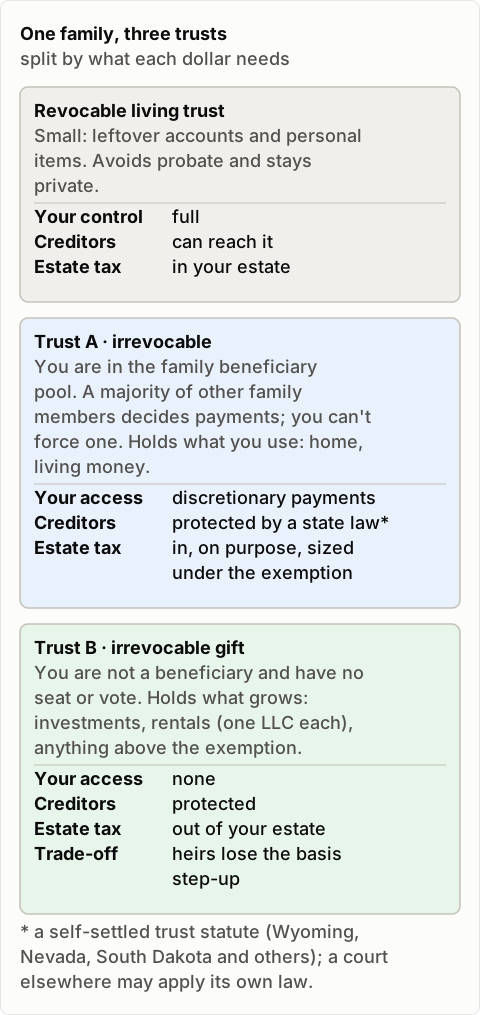
Two honest caveats. Trust A leans on a self-settled trust law, and a court in a state without one may apply its own law. The plan needs real substance in the trust's state (an actual trustee there, books and administration actually done there), not just a mailing address. And the trade-off on B is real: anything you move out of your estate loses the step-up, so your heirs owe capital gains later instead of estate tax now. Below the exemption, my notes' advice was: don't bother, keep the step-up.
On cost, one detail stood out. Wyoming lets a resident individual, including a family member, serve as the in-state trustee. South Dakota and Nevada in practice need an in-state trust company, which my notes put at roughly $3,000 to $15,000 a year.
None of this works if you do it late
The protection only holds for transfers made when there's no claim on the horizon. Moving assets after a claim exists, or when one is foreseeable, is a fraudulent transfer, and a court will unwind it no matter how good the design is. For self-settled trusts, federal bankruptcy law can reach back ten years for transfers made to get around creditors. And if the committee approves every request you make, a court will see through it. The family has to actually say no sometimes, and the minutes have to show it.
The line from my notes I liked best: legitimate asset protection survives being fully seen. In a post-judgment exam you answer under oath about every transfer, and lying there is perjury. Everything here is supposed to hold up in open court. Once a plan depends on a creditor or the IRS not finding out, it's become concealment, and concealment loses. With the IRS it's the opposite of hiding: filing a gift tax return that fully discloses a transfer starts a three-year clock for challenging its value. Without that, the valuation stays open indefinitely.
Where your name actually shows up
The privacy half started with a simple goal: as few public appearances of my name as possible. It helped to split "who can see it" into four audiences.
- The public, including anyone researching you before a lawsuit. They only get public records and data brokers. Entity design can close the public records almost completely, and this is the audience the whole exercise is for.
- A creditor who already has a judgment. They get your testimony under oath and subpoenas. Structure adds cost and friction, not secrecy.
- The government (IRS, FinCEN, the county assessor). They get what the law says they get, and you don't want to hide from them.
- Banks, title companies, lenders and insurers. They have identity checks they can't waive. Your name only moves if someone else really holds control.
For a property held in an LLC, these are the places a name leaks:
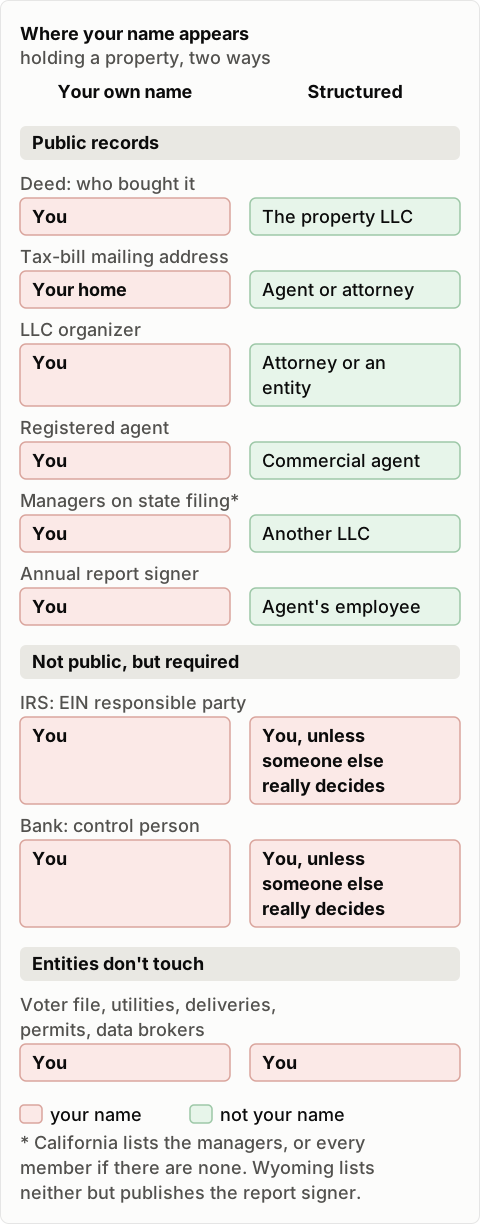
- The recorded deed. It names the buyer. With a trust on title it names the trustee and the trust's date, though the trust document itself is never recorded. With an LLC on title it shows only the LLC's name.
- The county assessor's roll. People forget this one. It shows the owner and the tax-bill mailing address. Send the tax bill to your home and you've undone the deed work.
- State filings. Wyoming's articles and annual report list no members or managers, but the report's signer is public. California's Statement of Information lists the managers, or every member if no manager is appointed. So an LLC there needs to be manager-managed, with another company as the manager. The organizer and registered agent also appear on the filings.
- The order you do things in. Buying into the entity at closing means a deed with your name on it never exists. Buying personally and deeding it over later leaves a permanent public deed in your name, a second recorded transfer, and in some states a property tax reassessment problem.
- The mortgage. Most residential lenders won't lend to an LLC, and moving a mortgaged house into one can trigger the due-on-sale clause. The federal Garn–St Germain exception covers a transfer into a living trust where the borrower stays a beneficiary and keeps living there. It doesn't cover LLCs, which is why a trust holding the title is often the practical route for a house that already has a loan.
Which roles a stranger can fill
The most useful exercise was breaking an LLC's formation into roles and asking, for each one, whether someone who never learns your name can fill it.
- Organizer: yes. They need the company name, purpose, address and agent, and nothing about the owners. One catch I hadn't seen advertised: in California the organizer also has to sign the cancellation when the company is eventually wound up, so pick one you can still reach in twenty years. Another company is more durable than a person.
- Annual report signer: yes. Agents routinely sign as "authorized individual" under an employee's name.
- Manager of record: no human needed. Another LLC can be the manager.
- Mailing address: yes, use an agent's or attorney's address. A virtual mailbox is weaker than it looks. USPS Form 1583 needs two IDs, and since 2023 mailbox providers upload them to a central USPS database. Some banks and registrars also reject those addresses.
- Registered agent: partly. The agent's name goes on the filing, but Wyoming requires the agent to keep contact details for a real person connected to the company. That record is private and exists anyway, though the person doesn't have to be you.
- EIN responsible party: no. The IRS requires an individual who actually controls the company and says plainly that nominees can't apply for an EIN or be listed on the form.
- Bank account: no. Under the customer due diligence rule the bank records everyone who owns 25% or more, plus one individual with significant responsibility to control the company.
That explains the anonymous-LLC industry. Providers sell the four roles that can be productized. My notes priced a typical package at $300 to $800 a year, and the only real recurring necessity in it is the registered agent, at about $99 to $149 a year. The usual upsell is a nominee manager, a person whose name goes on the public list while you run things privately. That's worse than using another LLC as manager: someone who relies on the public filing can treat the nominee as able to bind the company, and you're the one indemnifying the nominee. Some firms also sell attorney-as-organizer as a privilege shield. But a client's identity generally isn't privileged, and a firm that only did clerical filing has the weakest claim of all.
Substitution, not indirection
This was the biggest correction to my own thinking. I went in picturing layers: an LLC owned by an LLC owned by a trust, each one a bit further removed. That does nothing at the bank or the IRS, on purpose. The IRS started requiring a person rather than a company as the responsible party because company-owns-company chains made it lose the trail. The bank rule looks through ownership held "through any contract, arrangement, understanding, relationship or otherwise."
Both rules ask the same question: who actually decides? The only honest way to change the answer is for a different real person to actually decide. Where a trust owns 25% or more of a company, the bank rule names the trustee as the owner, not the beneficiaries. So beneficiaries stay private by default. Nothing about them is filed with a state, though the IRS sees them on the trust's tax forms when they're paid. Your name comes off an account only when a trustee or officer who isn't you really holds control.
That was the neat part for me: privacy at the bank and asset protection are the same purchase. Both need real independence, and you can't buy either while keeping full control. Anything that promises otherwise is selling a false certification. Wealthier families get there with a private family trust company (Wyoming has a statute for these) whose officers hold the control. Smaller setups use an independent trustee.
Extra layers can also hurt you. Paying one LLC's bills from another LLC's account is commingling, a classic fact pattern in veil-piercing cases, where a court ignores the LLC and goes after the owner. If you have several entities, each gets its own account, and money moves between them under a written management agreement at a fair fee.
What changed recently
- Beneficial ownership (BOI) reporting under the Corporate Transparency Act. For a while every small LLC was expected to report its owners to FinCEN. FinCEN's page, updated August 11, 2026, says the final rule exempts US companies and US persons, effective August 14, 2026. Only foreign companies registered in the US still report. My notes also mention a government audit report objecting and ongoing litigation, so I wouldn't assume it's permanent. Even when it applied, it was a confidential database, not a public one.
- Residential real estate reporting. FinCEN's rule requiring a report on cash (non-financed) transfers of homes to an LLC or trust, with no dollar threshold, was set to start March 1, 2026. My notes treated it as live. FinCEN's page says a federal court in Texas vacated the rule on March 19, 2026, the government has appealed, and while that order stands nobody has to file. Check its status before any cash purchase. The report was never public, and a financed purchase was outside the rule anyway, because the lender already has to know who you are.
- The estate tax exemption. The 2025 tax law set it at $15 million per person from 2026, indexed for inflation, according to my notes. It's political and has moved before.
Things entities don't touch
The most deflating finding: most real-world identification of a homeowner doesn't come from public records at all. It comes from the voter file, the DMV, utilities, deliveries, insurance, building permits, contractors, neighbors and data brokers. An LLC changes none of those. Entity layering mostly closes the public-records channel, does nothing at regulated intermediaries, and does nothing in daily life. If privacy is the goal, a lot of the remaining work is there.
What I'm still unsure about
- How a court in a state without self-settled trust laws treats an out-of-state one. It depends on the facts and on how real the out-of-state administration is.
- Whether a completed-gift trust where you're also a beneficiary is out of your estate. There's an argument for it, but it's the contested version, and the two-trust split exists to avoid relying on it.
- Bank behavior: whether a given bank accepts a trust company officer as the control person, or rejects a virtual mailbox address. That varies by institution.
- Property tax reassessment when moving property into an entity, which is entirely state rules.
- The dollar figures above are ranges from my notes, not quotes.
If I had to compress it: a revocable trust covers probate and keeps who-inherits-what private; buying property into an entity from day one, with an agent's address everywhere, covers the public records; the irrevocable trusts only earn their cost near the exemption or with real liability exposure; and none of it replaces a lawyer who knows your state.