Electroforming scrap copper is cheaper than buying copper
Ryle ·
Say you need a few hundred pounds of copper for something like a custom water-cooling loop: cold plates, manifolds and heat-exchanger shells. I'd been reading about electroforming for a metal-reshaping side project, so I priced buying the copper against growing it out of scrap. I expected buying to win easily. It didn't. Copper in small retail orders is very expensive per pound, scrap is cheap, and the electricity to move copper from one to the other costs almost nothing.
I did this pricing in early 2026 and rechecked every number in November before writing it up, so the prices below are the November ones.
What copper costs, depending on how you buy it
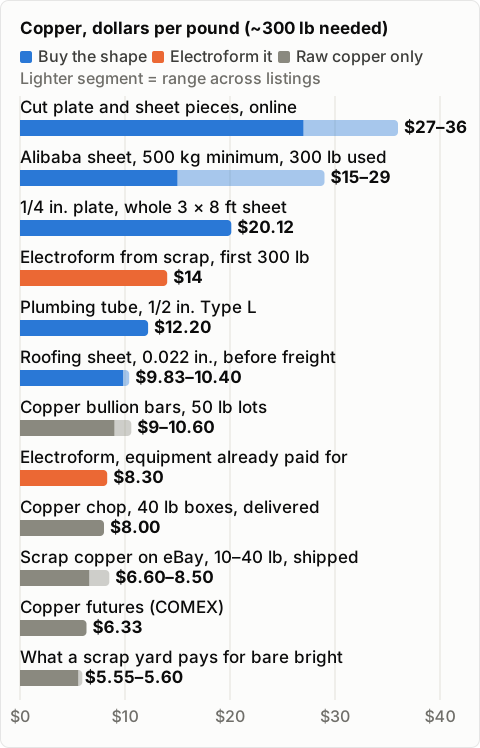
This is what I found. All prices are per pound of copper, and the copper futures price was about $6.33 a pound when I checked.
| Route | $/lb | What the number assumes |
|---|---|---|
| Cut C110 plate and sheet, online retailer | 27–36 | Pieces from 15 to 70 lb at KMAC, e.g. 0.093" × 12" × 48" for $625.68 (17.3 lb). Shipping extra. |
| 1/4" C110 plate, a full 3 × 8 ft sheet | 20.12 | $5,600.64 for 278 lb at OnlineMetals. A 1 × 1 ft piece of the same plate is $27.36/lb. Shipping extra. |
| Small cut bar | ~18 | A 3.2 lb C110 bar from Online Metal Supply for $57.22. |
| Alibaba sheet, 500 kg minimum | 8–12 | Per pound of the whole 1,100 lb order, after freight, US fees and a 50% tariff. Below. |
| Plumbing tube, 1/2" Type L | ~12 | $34.77 for 10 ft at American Copper & Brass, 2.85 lb. Only useful if you need tube. |
| 16 oz roofing copper (0.022"), 3 × 10 ft sheets | 9.83–10.40 | $295 per 30 lb sheet at Old World Distributors, plus an $85 skid charge and freight; GutterSupply is about $10.40. Thin sheet only. |
| Bare solid wire, 1,000 ft reels | 12.99–13.34 | 2 to 6 AWG at Nassau National Cable, free shipping over $1,000. Clean anode feed of a known alloy. |
| Copper "bullion" bars, 50 lb lots on eBay | 9–10.60 | $450–529 with free shipping. Pure copper in lumps, not a shape. |
| .999 copper chop, 40 lb boxes | 8.00 | $319.99 a box with free shipping at Liberty Copper, also for seven boxes. Purity is the seller's claim, with no certificate. |
| Scrap #1 or bare bright on eBay, 10–40 lb | 6.60–8.50 | Including shipping, e.g. 40 lb of clean pipe for $199 plus $64.65. |
| What a scrap yard pays you | 5.15–5.60 | Clifton Metals: bare bright $5.60, #1 $5.30, #2 $5.15. |
The eBay numbers come from search-engine copies of listings, because eBay's bot blocking stopped every way I tried to load the listings directly, including through a residential proxy. They're asking prices, not completed sales, and some had already sold. The one scrap-priced source I could check directly lands in the same range: Liberty Copper sells .999 copper chop at $8.00 a pound delivered in 40 lb boxes, and its cart showed free shipping even for seven boxes.
The first thing that surprised me is that scrap on eBay costs more than the futures price. You're paying someone to sort it, box it and ship it, and that's still far cheaper than any shaped copper you can order. The second is how steep the retail curve is. KMAC's own price list runs from about $83 a pound for a 1 lb strip down to about $27 for a 70 lb plate, and OnlineMetals charges $27 a pound for a square foot of 1/4" plate but $20 a pound if you take the whole 278 lb sheet. Small orders pay for cutting, handling and a distributor's minimums.
There are cheaper dealers if you look outside metal-service websites. Roofing and gutter suppliers sell 16 oz copper, about 0.022" thick, at around $10 a pound before freight, because they sell a lot of it. Wire distributors sell bare solid wire on reels at about $13 delivered, and bullion-style sellers sell copper chop and bars at $8–10 with free shipping. The catch is that each of those is a fixed form: thin sheet, wire or lumps.
Imports don't fix this anymore. Since August 2025 the US has charged a 50% Section 232 duty on semi-finished copper, meaning sheet, tube, rod and wire. It was first charged on the copper content only, and since April 2026 it has been charged on the full value of the article. Scrap and cathode are excluded, which is a nice fit for this plan.
The Alibaba route
I tried to find an Alibaba supplier who would send a few hundred pounds of sheet to a house, and couldn't. Every supplier I looked at wanted a freight order or quoted air shipping that cost more than the copper. A typical C11000 sheet listing (this one) is $10/kg with a 500 kg minimum, ocean freight "from $0.84/kg", 17–24 days in transit. $10/kg is below the price of copper itself (about $14/kg), so I read it as bait for a quote rather than a real price. I'd expect a real quote around spot plus a processing fee, call it $15–16/kg, but that part is my guess.
For 500 kg (1,102 lb), adding $0.84/kg freight, the 50% tariff, and roughly $800 for the US side (port fees, a customs broker, delivery with a liftgate to a house; this guide and others put those at a few hundred dollars each):
- At the listed $10/kg: about $8,700, or $7.90 a pound.
- At $15.50/kg: about $12,800, or $11.65 a pound.
That's not bad per pound, but you have to buy 1,100 lb to get it. If you need 300 lb and sell the other 800 lb back to a yard at about $5.20, the 300 lb you keep cost $15–29 a pound. You're also the importer of record for a tariffed metal and waiting a month or two.
Electroforming from scrap
Electroforming is electroplating that keeps going until the plating is the part. You hang a mandrel (a shaped core with a conductive surface) in an acid copper sulfate bath, put copper on the other side as the anode, and run current. Copper dissolves off the anode and deposits on the mandrel. If the anode is scrap, the scrap turns into your part, and most impurities stay behind.
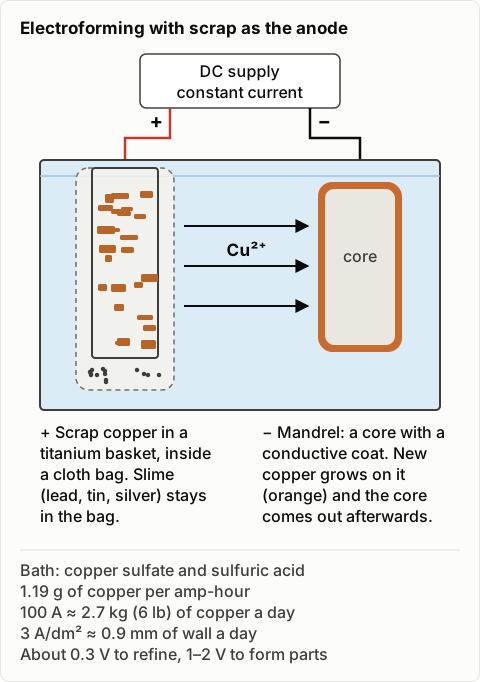
The math is Faraday's law. Copper goes in as Cu²⁺, two electrons per atom, so one amp-hour moves 1.186 g of copper. Assume 95% of the current does useful work, and one pound takes about 403 amp-hours.
Energy is close to free. Industrial refineries run at about 0.3 V per cell and about 300 A/m², which works out to roughly 250–300 kWh per tonne. A hobby tank making parts will be worse, because the electrodes are farther apart, the geometry is awkward and you may push current density for speed. Say 1–2 V. At 1.5 V and an 85% efficient supply, that's about 0.7 kWh per pound. At the US average residential rate of 18.16¢/kWh it costs 13 cents a pound. At California's 29.75¢ it's 21 cents. Even at 2 V and California prices it stays under 30 cents a pound, against a $20+ gap between scrap and plate.
Time depends on wall thickness and amps. Acid copper is normally run at 2–5 A/dm². At 3 A/dm² the wall grows about 38 µm an hour, a little under a millimeter a day, on every part in the tank at the same time. A part with a 0.5 mm wall is done in about 13 hours whether there's one of it in the tank or forty. What the number of parts changes is the current you need: every square meter of mandrel takes about 300 A at that density. A 100 A supply covers about 0.33 m² and deposits about 2.7 kg (6 lb) a day, so pounds per day is a question of how big a supply you buy.
Thin walls are also usually enough for a cooling loop. The stress in a tube wall is pressure times radius divided by wall thickness. A loop at 1 bar with 20 mm tubes and a 0.3 mm wall sees about 3 MPa, against roughly 180 MPa for even a plain, coarse deposit. Car radiator tubes are a few tenths of a millimeter or less. What sets the minimum wall for a loop is handling, fittings and pinholes, and you need far less copper than a few hundred pounds of solid plate would suggest.
A worked example: 300 lb
Here's 300 lb of formed copper from eBay scrap, with one 100 A supply running around the clock. Several of the equipment prices are my estimates and marked as such.
| Item | Cost |
|---|---|
| Scrap feed: 316 lb at $7.50/lb shipped (about 5% lost to slime and leftovers) | $2,368 |
| 100 A, 15 V constant-current supply (ATO) | $859 |
| Two used titanium anode baskets and bags | ~$120 |
| Tank, filter or air pump, bus bars, mandrel coating, PPE (my estimates) | ~$450 |
| 200 L bath: 100 lb copper sulfate ($125.77 per 50 lb), 2 gal of 93% sulfuric acid, chloride and additives | ~$358 |
| Electricity: ~213 kWh at the supply plus ~72 kWh for a pump, at 18.16¢ | ~$52 |
| Total | ~$4,200 ($14.02/lb) |
The same 300 lb as cut plate is $8,100–10,800, or about $6,000 if a single full sheet of 1/4" plate covers your parts. So the first 300 lb cost about half as much as buying cut pieces and about 30% less than the full sheet, with all the equipment paid off in that one run. If you'd rather not trust eBay for the feed, Liberty's chop at $8.00 raises the first batch to about $14.55 a pound. A second batch on the same equipment is mostly scrap and comes to about $8.30 a pound. An earlier back-of-envelope I'd done had deposited copper at about $19/kg ($8.60 a pound), which is close.
300 lb is about 121,000 amp-hours. On one 100 A supply that's 50 days of continuous running, which is the slow way to do it. Days are really set by wall thickness: 300 lb of copper with 1 mm walls is about 15 m² of part, which grows in a little over a day at 3 A/dm² if you can supply the 4,500 A that takes, and 300 lb of 4.5 mm walls is about 3.3 m² and five days at 1,000 A. A 1,000 A plating rectifier is $650–850 from a Chinese factory, with the same freight problem as the sheet, or $3,849 from ATO, and it wants three-phase power. On house power, a few 100–200 A supplies on separate tanks is the realistic version, and each one you add takes days off. The 200 L bath also holds about 10 kg of copper in solution, which you get back at the end or carry into the next job.
There's one more advantage I hadn't counted at first. If you machine a cold plate out of a block, a lot of what you paid for leaves as chips, and yards pay about $4.15 a pound for turnings. With electroforming, trim and rejected parts go back into the anode basket.
What the scrap has to be
This only works with clean copper. Bare bright wire and #1 pipe dissolve almost completely. Insulated wire has to be stripped first. As-is, a yard pays $2.85 a pound for Romex and $1.60 for Cat 5/6 cable, because a lot of it isn't copper. Brass is a different story: its zinc dissolves along with the copper and builds up in the bath, and lead and tin from solder end up as slime. Nickel and iron accumulate as well. A bag around the anode catches the slime, but anything that dissolves stays in the bath and eventually has to be dealt with.
Plumbing pipe is a happy accident here. It's C12200, phosphorus-deoxidized copper with 0.015–0.040% phosphorus, and acid copper plating anodes are deliberately made with 0.04–0.06% phosphorus so they dissolve evenly with less sludge. Scrap pipe sits at the low end of that. I'd expect it to behave reasonably as an anode, but I haven't seen anyone test it.
The deposit's properties depend on the bath. A plain high-copper sulfate bath gives coarse copper around 180 MPa tensile. Additives, low-copper baths, strong agitation or periodic current reversal get into the 250–440 MPa range with decent elongation. For a cooling loop strength is rarely the issue, since pressures are low. What I'd worry about is porosity at nodules and edges, where current crowds. I'd pressure-test every part.
When buying is cheaper
- Small quantities. The supply, tank and chemistry are about $1,800 up front. Against $30/lb plate that pays for itself at roughly 80 lb of parts. Below that, buy.
- Stock shapes. If tube or flat sheet will do, buy it. Plumbing tube at about $12 a pound is close to the first-batch electroforming cost, and to beat it you'd have to make around 430 lb of copper on the same equipment. If your parts can be cut, folded and brazed from 16 oz roofing sheet at roughly $10–12 a pound delivered, that beats a first batch outright. Electroforming earns its keep on shapes that sheet and tube can't make: closed channels, manifolds, fins grown in place.
- Thick or solid parts. Electroforming is good at shells, roughly 0.5–5 mm thick. A 25 mm block would take about a month in the tank and come out nodular. Melting and casting scrap is the better tool there.
- Your time. A tank running for weeks still needs bath maintenance, filtering, checks for treeing at edges, and mandrels made for every part. If you'd bill for those hours, the savings disappear quickly.
- Certified material. If you need a specific temper, a mill cert or a pressure rating, buy it.
- Cheaper scrap or a trade account. These change the numbers in opposite directions. Copper bought locally near yard prices (about $5.50) takes another $2 a pound off. I don't know how many yards will sell to individuals, so that's unverified. A business account at a metals distributor gets plate much closer to spot than the retail prices above.
Also budget for safety and disposal. Concentrated sulfuric acid causes serious burns, and copper sulfate is toxic to aquatic life, so a spent bath can't go down the drain.
So is it cheaper?
Mostly, yes. For a few hundred pounds of copper in a custom shape, electroforming scrap cost about half as much as buying cut plate in the first batch, about 30% less than a full sheet of plate, and about a quarter as much as cut plate after that. Electricity was a rounding error. Alibaba only looks competitive per pound if you actually want half a tonne and are willing to import a metal with a 50% tariff on it. It loses for small jobs, for anything a plumbing supply already sells, and for thick solid parts. For thin-walled parts with a lot of surface area, which is most of a cooling loop, the tank time is shorter than I expected and mostly a question of how many amps you buy.
Sources
- CBP CSMS #65794272: Section 232 duties on copper and Logistic Intel on the April 2026 full-value change
- KMAC Distribution: C110 sheet and plate prices
- Clifton Metals and Rockaway Recycling scrap buying prices
- MetalCharts: copper price
- EIA Electric Power Monthly, Table 5.6.A (residential electricity prices)
- BJ Holland: copper electrorefining operating parameters
- KME Cu-DHP datasheet and Luvata copper anodes